
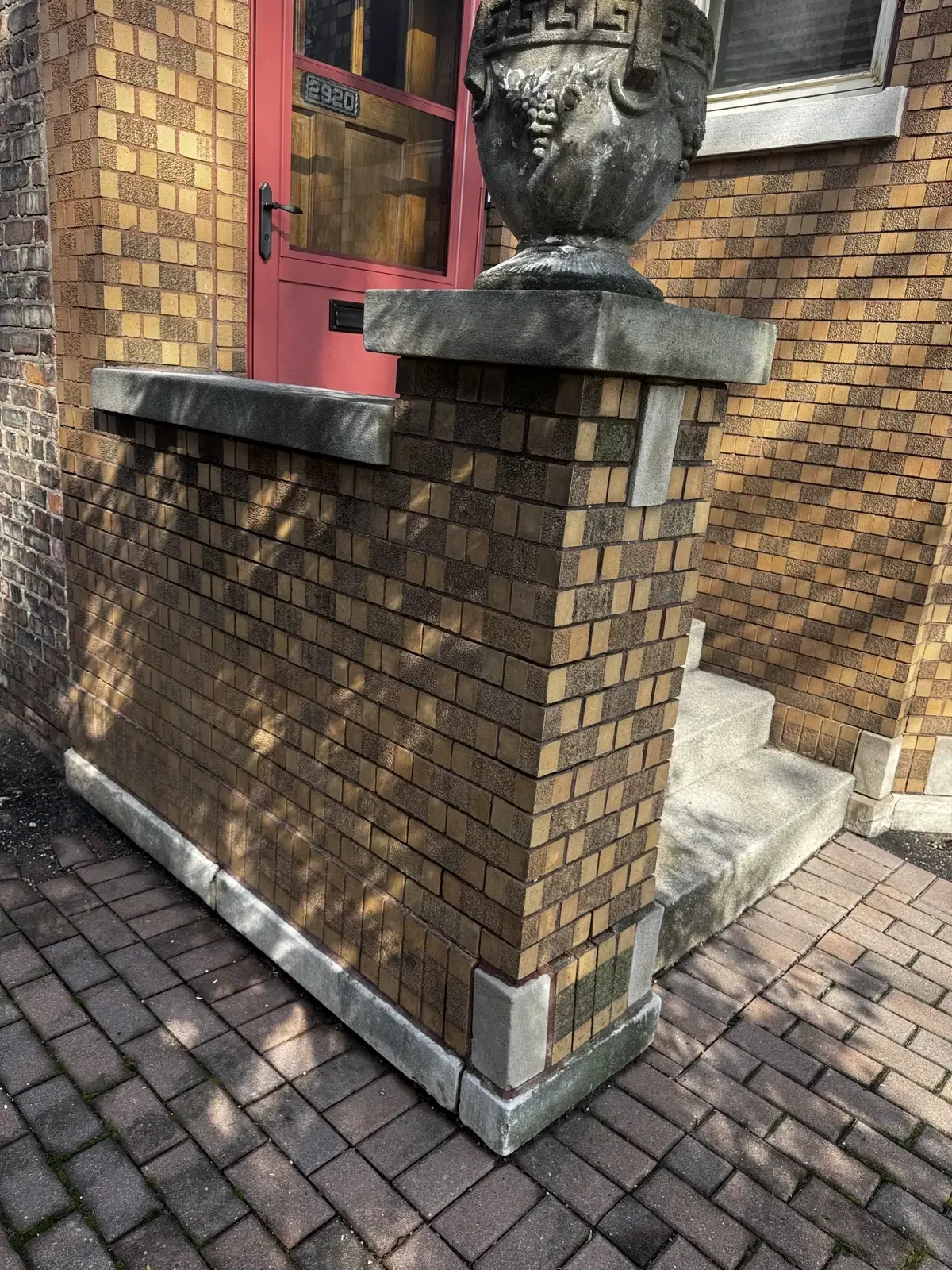
The brick walls flanking the sides of your front stairs are known as wingwalls. Because they are the entry point to your home, they are highly visible — and unfortunately, they are often the first masonry on your property to fail.
Unlike the main walls of your house, wingwalls are fully exposed to the elements on multiple sides and lack the ambient heat from the building's interior to help dry them out. Combined with Chicago's brutal winters, these walls take a constant beating.
If the brickwork around your front steps is cracking, crumbling, or pulling away from the house, here is what is causing it and how we determine whether it needs a simple repair or a full structural rebuild.
3 Common Causes of Wingwall Failure
1. Frost Heave and Shallow Foundations
The most common reason wingwalls fail in Chicago is a lack of a proper frost-depth foundation. To survive our winters without moving, a masonry foundation needs to sit below the frost line (at least 42 inches deep in the Chicagoland area). Historically, many builders poured shallow footings for front steps to save time and money. When the ground freezes and expands, it pushes the entire wingwall upward and outward, causing it to separate from the main house.
2. De-Icing Salt Damage
Because wingwalls sit right next to the stairs, they are constantly exposed to rock salt and calcium chloride used to melt winter ice. When salty water splashes onto the porous bricks and mortar, it absorbs deep into the masonry. As the water evaporates, the salt crystals are left behind. These crystals expand inside the brick, causing the hard outer face to pop off — a process known as spalling.
3. Trapped Moisture and Hydrostatic Pressure
Many wingwalls act as small retaining walls, holding back the dirt or concrete fill sitting under the porch landing. If the wall does not have proper drainage (weep holes), rainwater soaks into the dirt behind the bricks. This wet, heavy soil creates hydrostatic pressure that physically pushes the wall outward. When that wet soil freezes in January, the expansion accelerates the bowing and cracking.
Tuckpointing vs. Rebuilding: Which Do You Need?
Property owners frequently ask if we can just "patch the cracks" where the wingwall meets the house. The answer depends entirely on whether the wall is still structurally sound and plumb (perfectly vertical).
When Repair and Tuckpointing is the Right Choice
If your wingwall is perfectly straight and has not separated from the main house, you are in good shape. Damage is likely limited to the surface.
The Solution: We can perform spot tuckpointing to grind out and replace deteriorating mortar joints. If the limestone or concrete coping caps on top of the walls are loose, we can lift them, install proper flashing underneath, and reset them to stop water from entering the top of the wall. If only a few bricks are spalled from salt damage, we can chisel them out and replace them individually.
When a Full Rebuild is Mandatory
Mortar is the glue that holds a wall together, but it is not a structural anchor. If your wingwall is leaning outward, bowing in the middle, or has a gap larger than a half-inch where it meets the main house, it has structurally failed.
The Solution: You cannot tuckpoint a leaning wall back into place; trying to fill a massive structural gap with mortar or caulk is a waste of money. The wingwall must be carefully dismantled. At Star Tuckpointing, we take the wall down to a solid base, correct the foundation or drainage issues causing the movement, and rebuild the wall straight and plumb. We tie the new masonry back into the main structure using stainless steel wall ties to ensure it never pulls away again.
Secure Your Entryway
A failing wingwall is more than an eyesore — it can compromise the stability of your front steps and become a tripping hazard or a liability.
// Free assessment
Noticed this on your home?
Family owned since 1992. Most of our work comes from referrals, so we'll give you an honest read on whether the issue is urgent or something that can wait a season.
Mon–Fri 8–5 · Sat 8–2
// Or send your details