
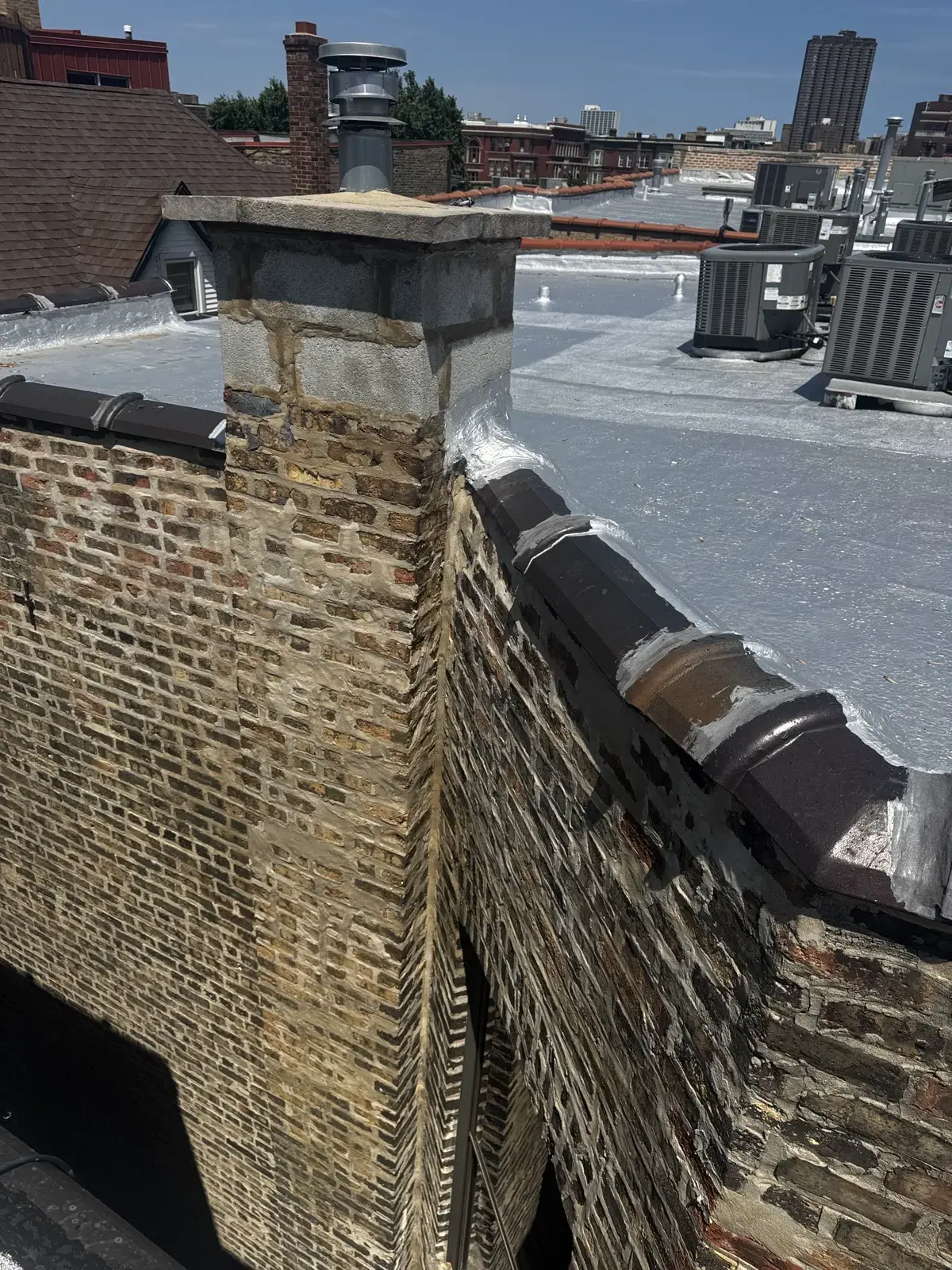
If you own a classic Chicago flat-roof two-flat or a commercial building, you have parapet walls. These are the short extensions of the exterior wall that project upward past the roofline. While they provide essential fire protection and visual appeal, they are also the most structurally vulnerable masonry on your entire building.
Unlike standard exterior walls, parapets do not have the protection of a roof overhang. Instead, they are exposed to Chicago's harsh weather on three sides: the front face, the back face facing the roof deck, and the top coping.
Because of this extreme exposure, parapet walls fail at a much faster rate than the rest of your building. Here is what you need to know about spotting damage, the difference between a repair and a full rebuild, and how to protect your property.
Why Parapet Walls Fail
Water infiltration is the enemy of all masonry, and parapets are uniquely designed to catch it. When rain and snow accumulate on a flat roof, the backside of the parapet absorbs moisture. If the coping stones on top are loose or missing flashing, water flows directly into the core of the wall.
Once winter hits, the Chicago freeze-thaw cycle takes over. The trapped water freezes and expands, blowing out mortar joints, cracking bricks, and eventually compromising the structural integrity of the entire wall.
4 Signs Your Parapet Wall is Failing
- Bowing or leaning — stand on the sidewalk and look straight up along the corner of your building. If the top courses of brick appear to lean outward toward the street, the internal structure has failed. This is a serious liability and a major safety hazard.
- Efflorescence — heavy white, powdery stains on the brickwork just below the roofline indicate that water is migrating through the parapet wall and pulling natural salts to the surface.
- Spalled or flaking brick — when bricks lose their hard outer face and crumble into a powdery mess, they have been destroyed by freeze-thaw damage and no longer hold structural weight.
- Deteriorated roof-side mortar — the backside of the parapet (facing the roof) often shows damage first. If the mortar is washed out or you can see daylight through the joints, water is getting directly behind your roof flashing.
Tuckpointing vs. Rebuilding: Which Do You Need?
Property owners often ask if a badly damaged parapet can simply be tuckpointed. The answer depends entirely on structural stability.
When Tuckpointing is Enough
If the bricks are in good condition, the wall is perfectly plumb (straight), and the damage is limited to recessed or washed-out mortar joints, tuckpointing is the correct solution. At Star Tuckpointing, we grind out the old mortar to a uniform depth and replace it with fresh, properly matched mortar to seal the wall against moisture.
When Rebuilding is Required
Tuckpointing is a waterproofing measure, not a structural fix. If your parapet wall is bowing, leaning, or features large sections of spalled and cracked bricks, smearing new mortar over it will not stop the wall from eventually collapsing.
In these cases, a partial or complete rebuild is required.
The Rebuild Process: We carefully dismantle the unstable sections of the wall down to a solid structural base. We then rebuild the wall using salvaged historical bricks (whenever possible) or matching new bricks, tied together with structurally sound mortar.
Coping and Flashing: A rebuild is only as good as its "roof." We finish the rebuild by resetting or replacing the clay tiles, limestone, or metal coping, ensuring proper flashing is integrated into the roofing membrane so water sheds correctly.
Don't Wait for a Code Violation
A failing parapet wall isn't just a threat to your roof — it's a major safety liability for the pedestrians and property below. The City of Chicago strictly enforces building codes regarding masonry facades, and a leaning parapet will result in severe fines.
// Free assessment
Noticed this on your home?
Family owned since 1992. Most of our work comes from referrals, so we'll give you an honest read on whether the issue is urgent or something that can wait a season.
Mon–Fri 8–5 · Sat 8–2
// Or send your details